What it does
5 and Fig. -A. 0), and the drift length xd = 5·Cb·Ss·(Ca(0)−1)/γ.
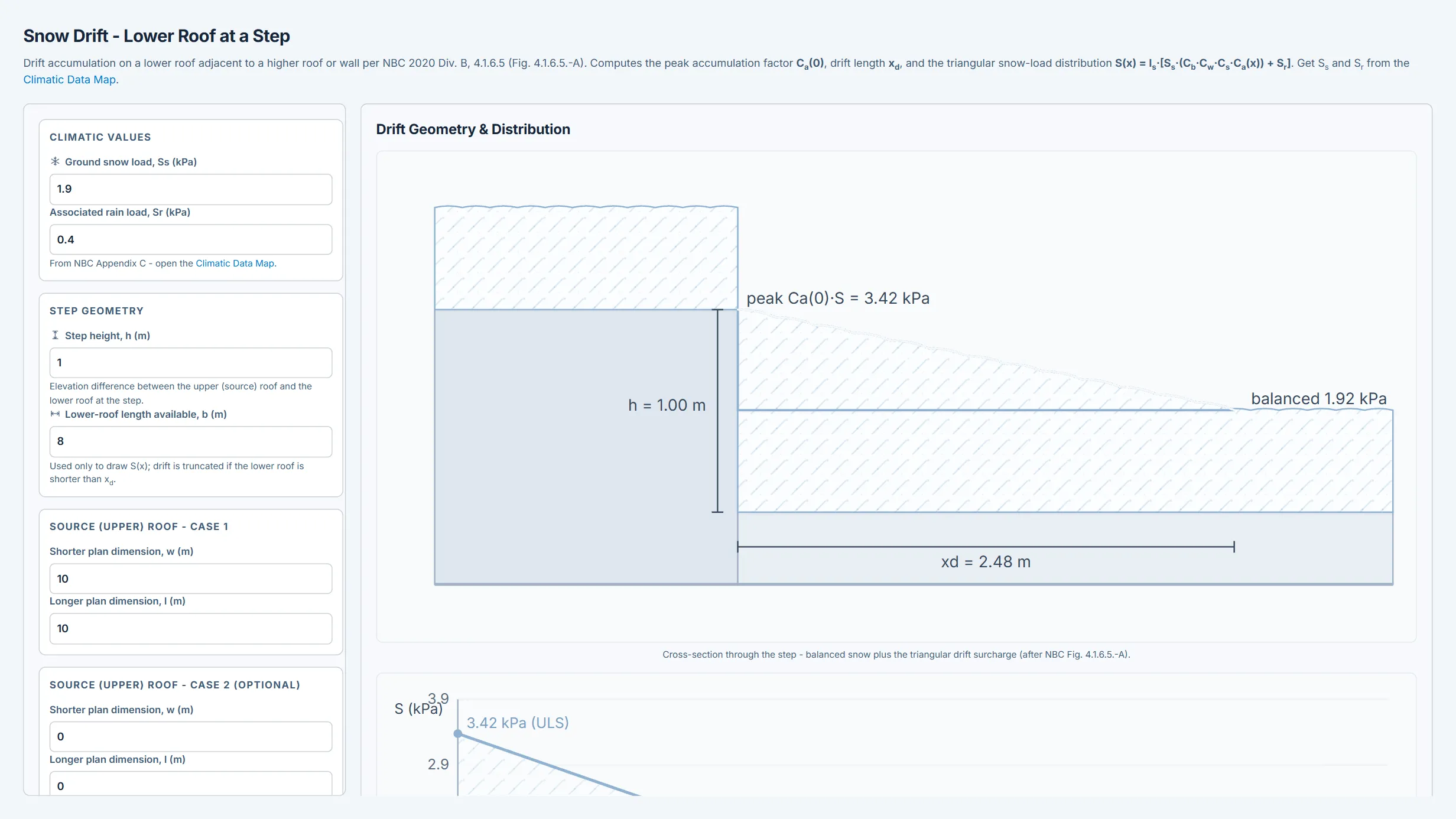
Builds the triangular accumulation factor Ca(x) and the specified snow load S(x) = Is·[Ss·(Cb·Cw·Cs·Ca(x)) + Sr] for ULS and SLS, evaluates up to two source-area (wind-direction) cases and reports the governing one, and draws a code-style cross-section of the balanced snow plus drift surcharge and the S(x) distribution along the lower roof. Accepts Ss/Sr deep-linked from the Climatic Data Map.
What it does not do
Lower-roof leeward drift at a step only. Sliding snow from the upper roof, unbalanced/partial loads, the upper-roof balanced load, and obstruction/valley drift are not covered - use the dedicated snow tools. 0 unless reduced for a separated higher building.
Ss, Sr, and Cw exposure eligibility are engineer-entered and must be confirmed against NBC Appendix C.
How to use it
Use for preliminary lower-roof drift loads. Confirm climatic values, source-area dimensions for each wind direction, β/separation assumptions, and all other snow load cases before design use.