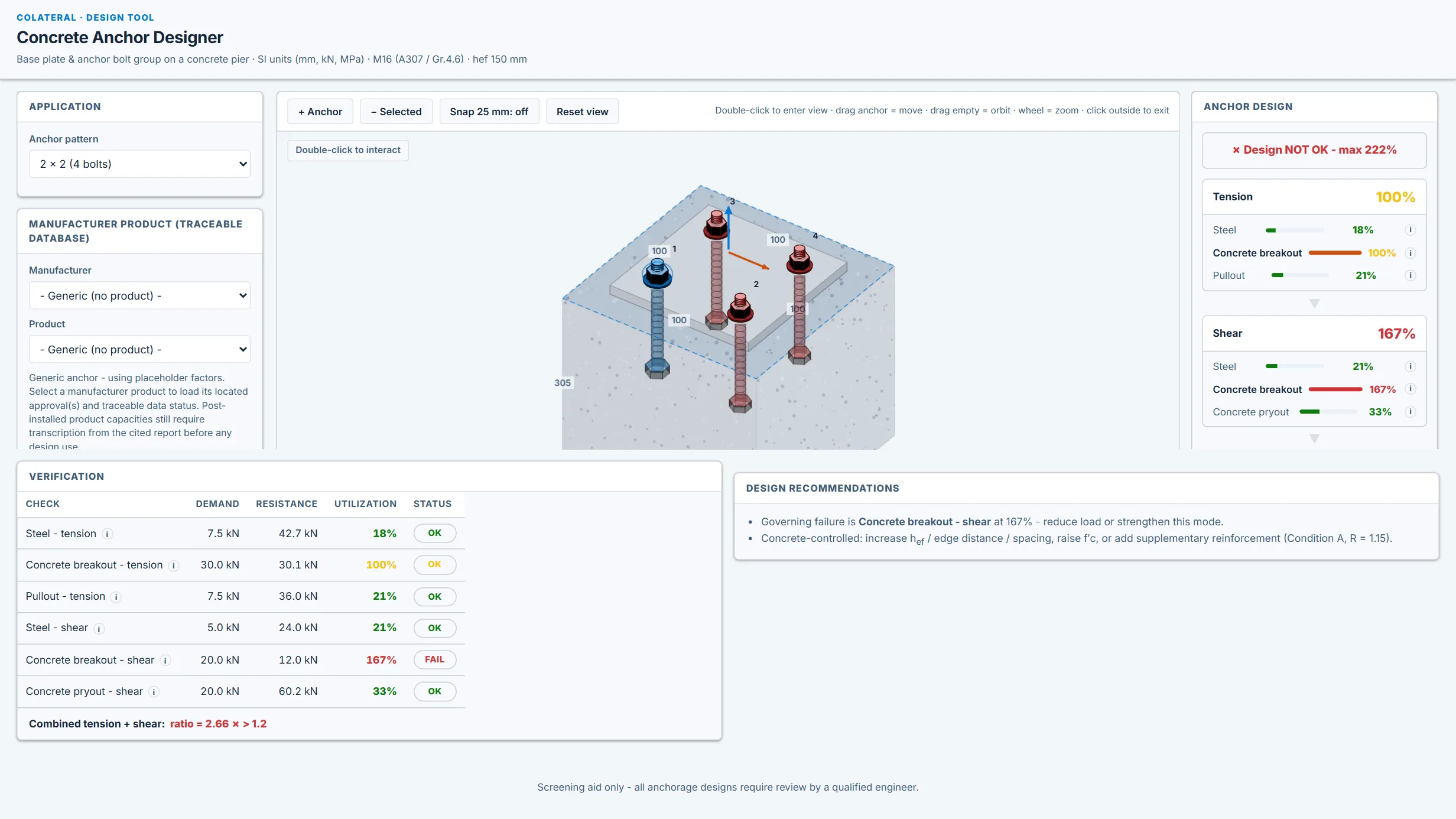
What it does
3-19 Annex D in a PROFIS-style workbench: specifications on the left, an isometric 3D model of the concrete member (extents, free vs continuous edges, breakout projection, base plate, load arrows) in the centre, the tension/shear/combination utilization flow on the right, and factored loads plus per-anchor forces at the bottom. Drag anchors to reposition them, change spacing, set edge distances and member thickness, and orbit/zoom the scene. Supports cast-in headed anchors and post-installed mechanical/adhesive anchors.
8). 3. Per-mode demand / factored resistance / utilization with pass-fail badges, a live calculation breakdown, recommendations, and copy/JSON/print export.
What it does not do
Preliminary screening aid only. Post-installed capacities use placeholder k, τ, and category values that MUST be replaced with the product's CCMC / ICC-ES report. A manufacturer database (Hilti / DEWALT / UCAN) is wired in for traceable selection, but numeric capacities are NOT yet transcribed - a named product shows 'Design incomplete' and the engine runs on generic placeholders until verified.
Assumes rigid base-plate elastic tension, equal shear sharing, breakout toward one governing edge, and overlapping cones (warns when spacing > 3·h_ef). No anchor-reinforcement, seismic amplification, standoff bending, or fatigue. Engineer review required for every output.
How to use it
Use for preliminary anchor-group layout studies and review-package preparation. Confirm the code edition, resistance factors, qualified product data, cracked/uncracked assumption, load combinations, and base-plate behaviour before any design use.